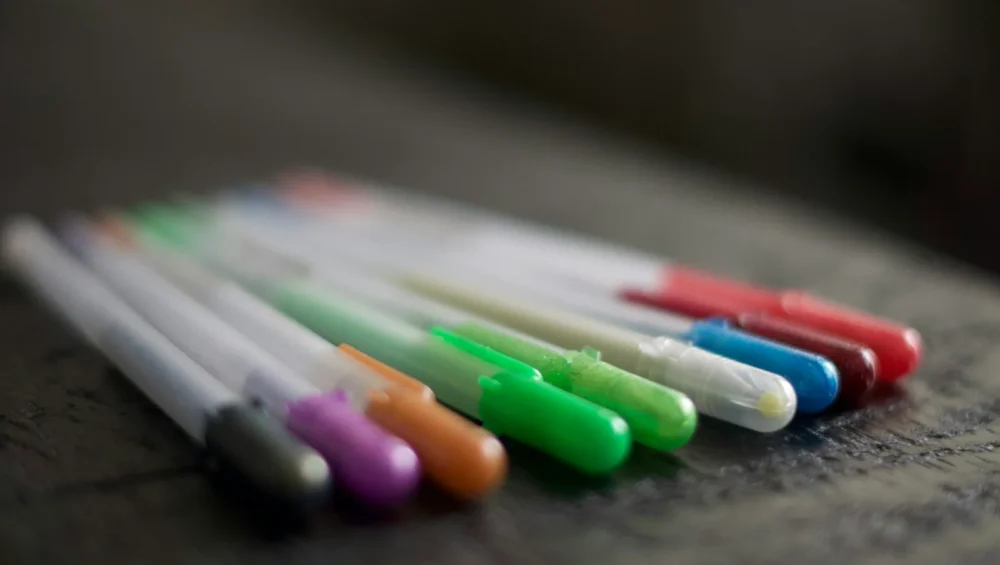
How do gel pens work? A gel pen carries a thick, water-based gel with fine pigment particles suspended in it. A tiny metal ball at the tip rolls as you write, picks up the gel from inside the pen and lays it on the paper in a smooth, bright line. The gel is thick enough to stay in the barrel, yet it thins as the ball turns, so it flows with very little pressure. This guide from Decent Stationery in Lahore explains the ink, the tip, the history and the differences from ballpoint pens.
Key Takeaways
- Gel ink is pigment held in a water-based gel, usually thickened with a gum such as xanthan.
- The writing point is a rolling ball in a metal housing, the same basic design as a ballpoint.
- The gel thins while the ball turns and thickens again at rest, which stops leaks.
- Gel pens need less pressure than ballpoints and give bolder lines.
- Gel ink dries by soaking into the paper, so left-handed writers should test the pen first.
What Is Inside a Gel Pen?
Short answer: a gel pen has a barrel, an ink tube, a thick gel ink and a ball point, with a thicker gel plug behind the ink to keep it from running back.
Wikipedia describes a gel pen as resembling a regular ink pen, with a barrel, a cap and an ink reservoir. At the rear of the ink tube sits a translucent, more viscous gelled “follower” that prevents leakage and backflow. The tip is built like a ballpoint tip, a stainless steel casing holding a ball of carbide or ceramic. Wikipedia gives the usual ball diameter as 0.3 to 1.2 mm and the full range of tip sizes as 0.18 mm to 1.5 mm.
| Part | What it does |
|---|---|
| Barrel and grip | Holds the pen and the ink tube. Some barrels have rubber grips |
| Ink tube | Stores the gel ink |
| Follower | A thicker gel behind the ink that prevents leakage and backflow |
| Metal housing | A stainless steel casing at the tip that holds the ball |
| Ball | Rolls on the paper and carries the ink out |
What Is Gel Ink Made Of?
Short answer: gel ink is a pigment suspended in a water-based gel, and the gel is a mixture of water and a thickener such as xanthan gum.
Wikipedia states that the ink uses pigment suspended in a water-based gel. The pigments are typically copper phthalocyanine, carbon black and iron oxides. The gel is water with biopolymers such as xanthan gum and tragacanth gum, along with some polyacrylate thickeners.
Dayspring Pens describes the result as a suspension, a mixture of finely distributed solid particles in a liquid. Because the particles are solid and sit in the gel instead of dissolving, the ink can carry glitter, metallic and opalescent particles as well as ordinary colours. Dayspring says a ballpoint, by contrast, mostly uses dyes, because large particles could clog its mechanism.
Why does gel ink show up so well?
The gel is thick and opaque. Wikipedia notes that this makes gel ink show up more clearly on slick surfaces and on dark paper than typical ballpoint or felt-tip inks.
How Does the Ink Get From the Tube to the Paper?
Short answer: the ball rolls against the paper, picks up gel on its inked side and leaves it behind as a line.
Gold Spot Pens explains that about half of the ball sits in ink inside the pen. As you write, the ball rolls and shows its inked side to the paper. The ink is deposited, and the next part of the ball turns into the ink to pick up more. The cycle is continuous, which the page says allows consistent, smooth lines.
How can ink be thick and still flow smoothly?
The answer is a property called shear thinning. We found it described in a patent for a pseudo-plastic water-based ballpoint ink (US6613135), which is a technical document and not a gel pen guide. The patent says the ink’s viscosity is reduced by the shear force that the rotating ball applies to the ink. When the pen is not writing, the higher viscosity keeps the ink from leaking and blobbing from the tip. The patent gives a working range of 100 to 4000 mPa·s, and notes that below 100 the ink blobs from the tip while above 4000 it does not follow the ball well. The patent does not use the word gel, so treat this as an explanation of the principle, not a statement about any one brand.
When and Where Were Gel Pens Invented?
Short answer: Sakura Color Products of Osaka, Japan, developed the gel pen in the early 1980s, and its first commercial model went on sale in 1984.
| Year | Event | Source |
|---|---|---|
| 1982 | Sakura files its Japanese patent on 20 October | Hamilton Pens |
| 1983 | The patent is extended to the United States | Hamilton Pens |
| 1984 | The Ball sign 280, the first commercial gel pen, is released in Japan | Wikipedia |
| 1988 | The Ballsign 80 launches in Japan and is renamed Gelly Roll for the US | Hamilton Pens |
| 1989 | The Gelly Roll is popular in the US and abroad | Hamilton Pens |
Hamilton Pens adds that Sakura tried egg whites, grated yam and seaweed as thickeners before choosing xanthan gum, a food additive an employee found in a newspaper advertisement. Wikipedia says the Gelly Roll reached America in the late 1980s, which agrees with the dates above. Unsharpen adds that the first model, the Ballsign 280, used dye-based ink, and that the later Ballsign 150 switched to pigment ink.
Gel Pen vs Ballpoint: What Is the Difference?
Short answer: gel ink is water-based and pigmented, and ballpoint ink is oil-based and mostly dyed, so the gel pen writes darker with less pressure but dries more slowly.
| Feature | Gel pen | Ballpoint pen |
|---|---|---|
| Ink base | Water-based gel | Oil-based |
| Colourant | Pigment particles | Mostly dyes |
| Pressure needed | Less | More |
| Line | Bold, bright, smooth | Thinner, duller |
| Drying | Soaks into the paper, slower on some papers | Fast |
| Colour range | Includes glitter and metallics | More limited |
| Typical tip | About 0.7 mm | About 1.0 mm |
The comparison follows Dayspring Pens and Hamilton Pens. Dayspring adds that gel pens work best on smooth, thin, non-absorbent paper, while a ballpoint writes on almost any paper. Hamilton Pens gives about 0.7 mm as the standard gel or rollerball tip and 1.0 mm for ballpoints. For the ballpoint side of the story, see our guide on how a ballpoint pen works.
Strengths and Weaknesses of Gel Pens
Short answer: gel pens write smoothly and boldly, resist water once dry, and can smudge before they dry.
Strengths named in the sources:
- Smooth writing with little pressure, which Hamilton Pens says suits long writing sessions.
- Strong colour, including metallic, glitter and fluorescent inks.
- Water resistance once dry. Wikipedia says many gel inks are not washed away after drying, and Dayspring says they resist fading.
Weaknesses:
- Dayspring says gel pens cost more, may skip or clog if unused, and may not work on some papers.
- Slower drying raises the risk of smudging, and extra liquid can feather or bleed through thin paper.
- Hamilton Pens says only some gel pens are refillable, so a single-use pen makes more waste.
The sources disagree on drying. Hamilton Pens calls gel quick-drying and helpful to left-handed writers, while Dayspring says it dries by soaking in and may smudge. The fair conclusion is that it depends on the paper and the formula, so write a line on your own notebook and touch it after a few seconds.
Does gel ink wash out of clothes?
Not easily once dry. Our guide on how to remove ink stains from clothes covers gel ink on fabric.
Can mistakes in gel ink be fixed?
Hamilton Pens says some formulas are erasable, but most gel inks are waterproof once dry. A correction pen is the usual remedy, as the guide on how to use one explains.
Choosing a Gel Pen in Pakistan
Short answer: pick the tip size and the use first, then the colour.
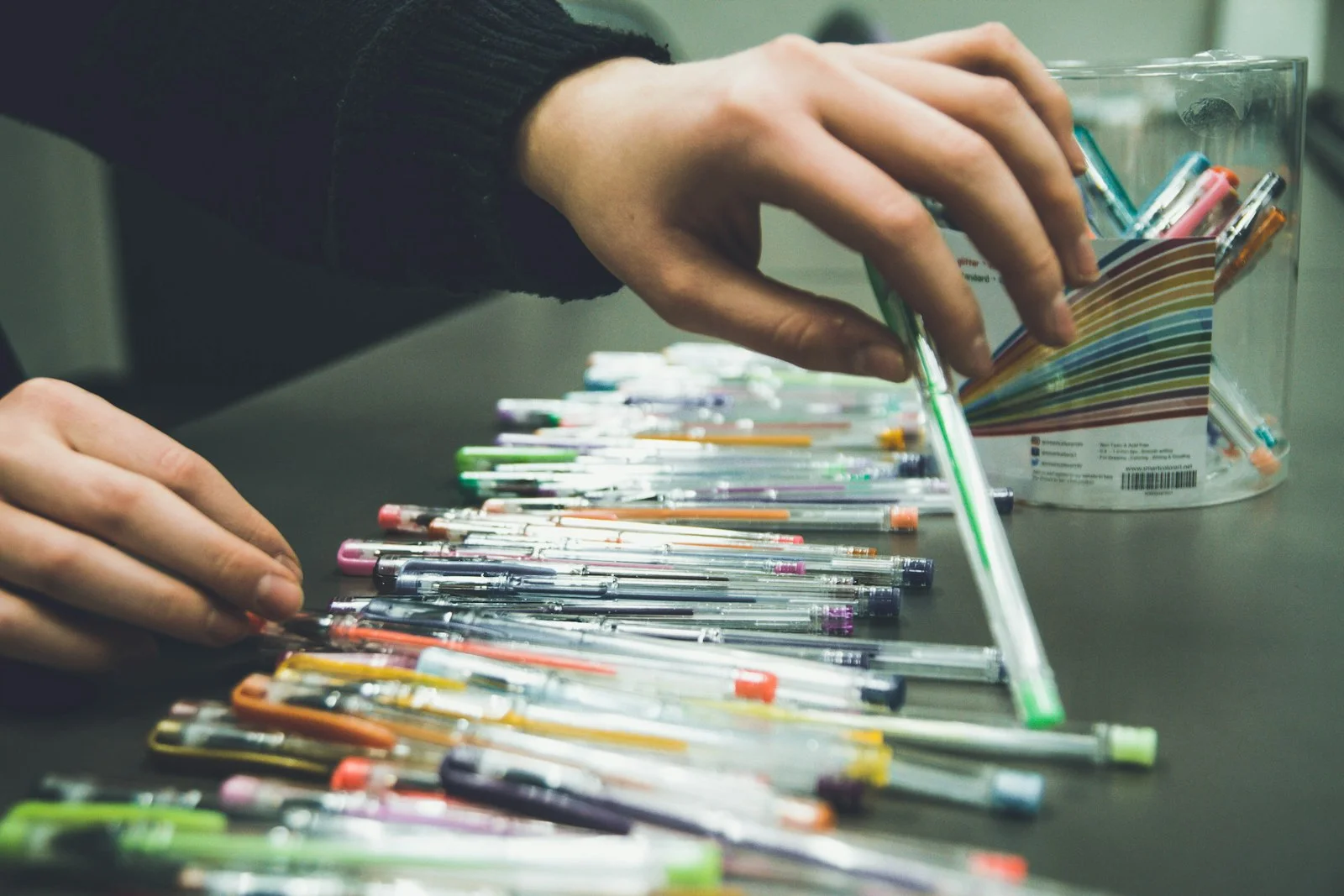
Decent Stationery lists several types of gel pen. The Uni-ball Signo Gel Grip Pen has a 0.7 mm stainless steel tip, a rubber grip and water-based pigment gel ink, according to its product page. The Piano Classic Gel Pen is listed with a 0.7 mm tip and black, blue and red ink, and is meant for school, office and home. The Glitter Gel Pens come as a pack of 12 with glitter ink and are meant for colouring books, journaling and craft. The page itself says they are not intended for formal handwriting.
A 0.7 mm tip in black or blue is a sensible start for notes. Prices change, so check the current gel pens price in Pakistan on the category page. If you prefer a pencil for rough work, see our lead pencil range too.
Frequently Asked Questions
A ball at the tip rolls on the paper and carries thick, water-based gel ink onto it. The gel thins as the ball turns, so it flows easily, and it thickens again when you stop.
Pigment suspended in a water-based gel, according to Wikipedia. The gel is water with thickeners such as xanthan gum, and common pigments are carbon black, copper phthalocyanine and iron oxides.
Gel ink is water-based and pigmented, and ballpoint ink is oil-based and mostly dyed. Dayspring Pens says gel needs less pressure and gives a bolder line, but a ballpoint dries faster and writes on more kinds of paper.
Sakura Color Products of Osaka, Japan. Hamilton Pens gives the patent filing date as 20 October 1982, and Wikipedia says the first commercial model, the Ball sign 280, came out in 1984.
Dayspring Pens says gel pens may skip or clog if left unused for a long time. Capping the pen after use is a sensible habit, and a few scribbles on scrap paper often restart the flow. That tip is our own advice and is not taken from the sources.
Many are water resistant once dry, says Wikipedia. Resistance varies with the formula, so do not assume that every gel pen is waterproof.
Conclusion
A gel pen works by rolling a small ball through a thick pigment gel that thins under the turning ball and thickens at rest. That single idea explains the smooth feel, the bold colour and the small risk of smudging. Test a pen on your usual paper before you buy a full pack, then browse the range at Decent Stationery.
Related Reading
Sources and Further Reading
- Wikipedia: Gel pen
- Gold Spot Pens: What Are Gel Pens and How Do They Work?
- Dayspring Pens: Gel Pen vs Ballpoint Pen
- Hamilton Pens: Great Everyday Pens, the Gel Pen
- Google Patents: US6613135, Pseudo-plastic water based ink for ballpoint pen
- Unsharpen: Who Invented the Gel Pen?
About the Author
Written by the Decent Stationery team in Lahore. We sell school, office and art stationery online across Pakistan, including gel pens, pencils and markers. Ink facts and dates come from the linked sources, and product details from our own product pages.