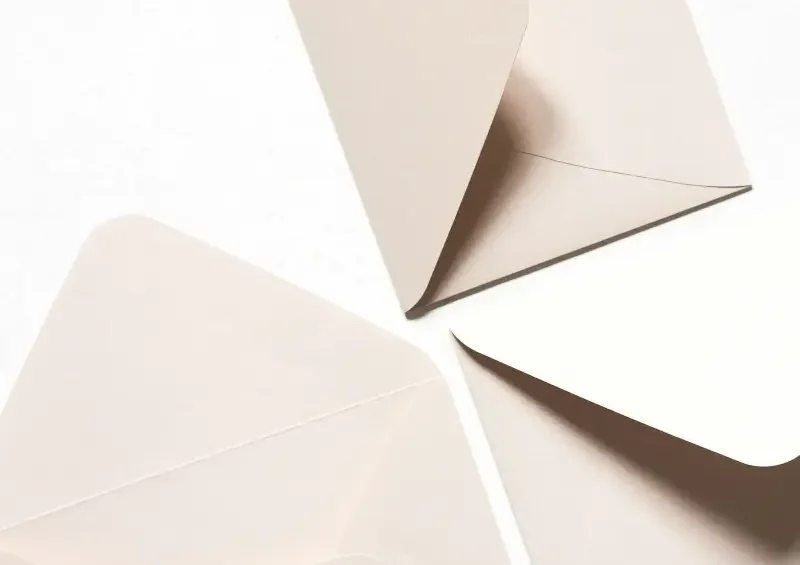
Here is how to make an envelope from a single sheet of paper. Trim the sheet to a square, fold the side corners to the centre, fold the top corner down and the bottom corner up, then tuck the loose corners under the middle panel so that the flap locks shut. No glue is needed if the envelope is handed over in person. This guide from Decent Stationery in Lahore gives two folding methods, the size each one produces, and advice on sealing and fixing common faults.
Key Takeaways
- Start with a square sheet. An A4 sheet becomes square with one fold and one cut.
- Plain printer paper suits a first attempt. Very thick card is hard to tuck.
- Seal with tape or a glue stick only if it will travel in a bag.
- A square of 30 cm gives an envelope of roughly 17 by 13 cm.
- Press every crease firmly, since the lock depends on the spring of the paper.
What You Need Before You Start
Short answer: one sheet of paper and a pair of scissors are enough, and the back of a spoon sharpens the creases.
Crafting Step by Step lists a sheet of A4 or letter paper, scissors or a craft knife, and a bone folder or the back of a spoon. Glue stick, double-sided tape, a sticker or a wax seal are optional and serve only to close the finished envelope. A glue stick such as the M&G Glue Stick 15g is convenient. Its product page describes the formula as non-toxic, acid-free and washable.
| Paper | How it behaves | Suited to |
|---|---|---|
| Plain printer paper | Creases sharply, says Crafting Step by Step | First attempts |
| Scrapbook paper, 65 to 80 lb | Called the sweet spot by the same page | Cards and gift envelopes |
| Gift wrap, magazine pages, kraft paper | Gathering Beauty says any paper works | Decorated or recycled envelopes |
| Cardstock above about 80 lb | Hard to tuck, since three layers pass through a gap meant for two | Best avoided |
The pound figures are American paper ratings, quoted as the source gives them.
How to Make an Envelope From a Square Sheet
Short answer: fold the corners to the centre in a set order, tuck the overlapping corners under the middle panel, and lock the bottom flap into the side pockets.
These eight steps follow the method published by Crafting Step by Step. Press each fold before moving on.
- Make a square. Fold the top right corner so that the short edge lies along the long edge. Trim off the strip left below the fold and open the sheet.
- Mark the centre. Bring the top corner toward the bottom and press only the middle inch or so. Open it again and keep the mark light.
- Fold the side corners in. Each point meets the centre mark, and the square becomes a tall kite shape.
- Fold the top corner down over the two side flaps.
- Fold the bottom corner up to the edge of the panel made in step 4 and crease firmly.
- Fold the side corners toward the centre. Keep both folds even, since they become the visible side seams.
- Tuck. Slide each overlapping corner under the middle panel. The source calls this the fiddly step and warns that forcing it tears the paper.
- Lock. Fold the bottom section up to the middle and slip the flap corner into the small pocket on each side.
An A4 sheet is 210 mm wide, so the square in step 1 has sides of 210 mm. Cutting along the fold with a ruler gives a cleaner edge than tearing, and the paper cutter guide covers straight cuts on larger batches.
How to Make an Envelope Without Glue: The Pinwheel Method
Short answer: fold a square sheet in thirds both ways, add diagonal and edge creases, collapse it into a pinwheel, and tuck in the last corner.
Homemade Gifts Made Easy describes a square envelope made from a square sheet, 12 by 12 inches (30 by 30 cm) in the example. The page states that the final envelope is one third of the size of the sheet, so about 4 by 4 inches (10 by 10 cm). Fold the sheet in thirds in both directions to form a grid. Add the diagonal creases and then the edge creases, turning the sheet a quarter turn each time. Turn it over, bend two corners into a bowl and push the sides inward until it collapses into a pinwheel. Fold in the corners one by one, clockwise, and tuck the last one under.
The page suggests the small square for a gift card, a piece of jewellery or a short letter.
How Big Will the Envelope Be?
Short answer: a handmade envelope is always smaller than its sheet, between one third and three fifths of the sheet’s width.
| Starting sheet | Finished envelope | Source |
|---|---|---|
| A4 or letter, trimmed square | About 4.75 by 3.5 in (12 by 9 cm) | Crafting Step by Step |
| 12 by 12 in scrapbook sheet | About 6.75 by 5 in (17 by 13 cm) | Crafting Step by Step |
| 12 by 12 in designer paper | About 7 3/8 by 4 3/8 in (19 by 11 cm) | Gathering Beauty |
| 12 by 12 in, pinwheel method | About 4 by 4 in (10 by 10 cm) | Homemade Gifts Made Easy |
How do you choose a sheet for a particular card?
Crafting Step by Step says its envelope is about 55 percent of the square’s width and 40 percent of its height. Divide the card’s width by 0.55 and its height by 0.4, take the larger answer as the side of your square, and add a margin of a centimetre or two. A card of 15 by 10.5 cm needs at least 27 cm, so a 30 cm square is safe. This is a calculation from the source’s ratio, so test it on scrap paper.
How to Seal, Line and Address a Handmade Envelope
Short answer: the lock holds without adhesive for hand delivery, and a glue stick, tape, sticker or wax seal makes it safe for a bag.
Crafting Step by Step says the lock relies on the spring of the paper. For an envelope carried in a bag it recommends a glue stick, double-sided tape, a sticker or a wax seal, and it discourages liquid glue because it soaks in and warps the front. Christine’s Crafts also folds its envelope without tape or glue.
To line the envelope, glue a thin patterned paper inside the flap after folding. Write the address on the front, since the back carries the stacked folded edges.
Common Problems and How to Fix Them
Why will the corners not tuck in?
The paper is probably too thick. Switch to a lighter sheet, crease the earlier folds again and slide each corner in gently.
Why does the envelope spring open?
Christine’s Crafts advises pressing every fold hard and running a fingernail along each crease. If a diamond-shaped part will not lie flat, it suggests placing the envelope under a heavy book.
A Practical Note for Pakistan
Handmade envelopes suit greeting cards, Eid and birthday cards, invitations and small gifts of money, and A4 printer paper is easy to find. For a class set or a wedding list, folding by hand becomes slow, and ready-made envelopes are the better choice.
Decent Stationery lists the Card Envelope Pack of 5. Its product page gives ten colour options, a printed “From:” field and an individual poly wrap for each piece. The full range is under envelope in Pakistan, though stock changes. If you also wrap presents, see the gift bags category, the guide on how to make a gift bag, and our notes on thoughtful stationery gift ideas.
A Short History of the Envelope
Wikipedia dates the first forerunners of the envelope, hollow clay spheres made around tokens of account, to about 3500 to 3200 BC. Paper envelopes came later in China, where they held gifts of money. In the West, until the middle of the nineteenth century, a letter was usually secured by folding and sealing the sheet itself.
The Smithsonian National Postal Museum records that early envelopes were made by hand, about 25 at a time, by stationery clerks who cut sheets with sharp knives and tin patterns and folded the flaps by hand. Both Wikipedia and the museum date the first patent for a folding machine to 1845.
Frequently Asked Questions
Trim a sheet of printer paper to a square and follow the eight folds in this guide. The method needs no glue and no tools beyond scissors. Practise once on scrap paper.
A 30 cm square gives an envelope of about 17 by 13 cm, according to Crafting Step by Step. A trimmed A4 sheet gives about 12 by 9 cm, which suits a folded note or a gift voucher.
Yes. Crafting Step by Step, Gathering Beauty, Homemade Gifts Made Easy and Christine’s Crafts all describe designs that stay closed by folding alone.
Plain printer paper is best for a first attempt, and middle-weight scrapbook paper gives a firmer result. Wrapping paper, kraft paper and magazine pages also work, says Gathering Beauty.
Christine’s Crafts says such envelopes may not be sturdy enough for the post, though they work well by hand. Crafting Step by Step notes that the United States Postal Service asks for envelopes at least 3.5 inches high and 5 inches long. That is an American rule. We did not find the rules of Pakistan Post, so ask at your local post office.
Conclusion
An envelope is one of the simplest paper projects. A square sheet, eight careful folds and a firm tuck are all it needs. Fold one on scrap paper first, check that your card fits, and then repeat with the sheet you have chosen. When you need a larger number, or a neat finish for a formal occasion, browse the ready-made range at Decent Stationery.
Related Reading
Sources and Further Reading
- Crafting Step by Step: How to Make a Paper Envelope, Easy Origami, No Glue
- Gathering Beauty: How to Fold an Easy Origami Envelope, No Glue
- Homemade Gifts Made Easy: Beautiful Origami Envelope, Folding Instructions and Video
- Christine’s Crafts: How to Make a Cute Origami Envelope with No Tape or Glue
- Wikipedia: Envelope
- Smithsonian National Postal Museum: Envelopes in the Machine Age
About the Author
Written by the Decent Stationery team in Lahore. We sell school, office and art stationery online across Pakistan, including envelopes, gift bags and craft supplies. Folding methods, sizes and dates come from the linked sources, and shop details from our own product pages.