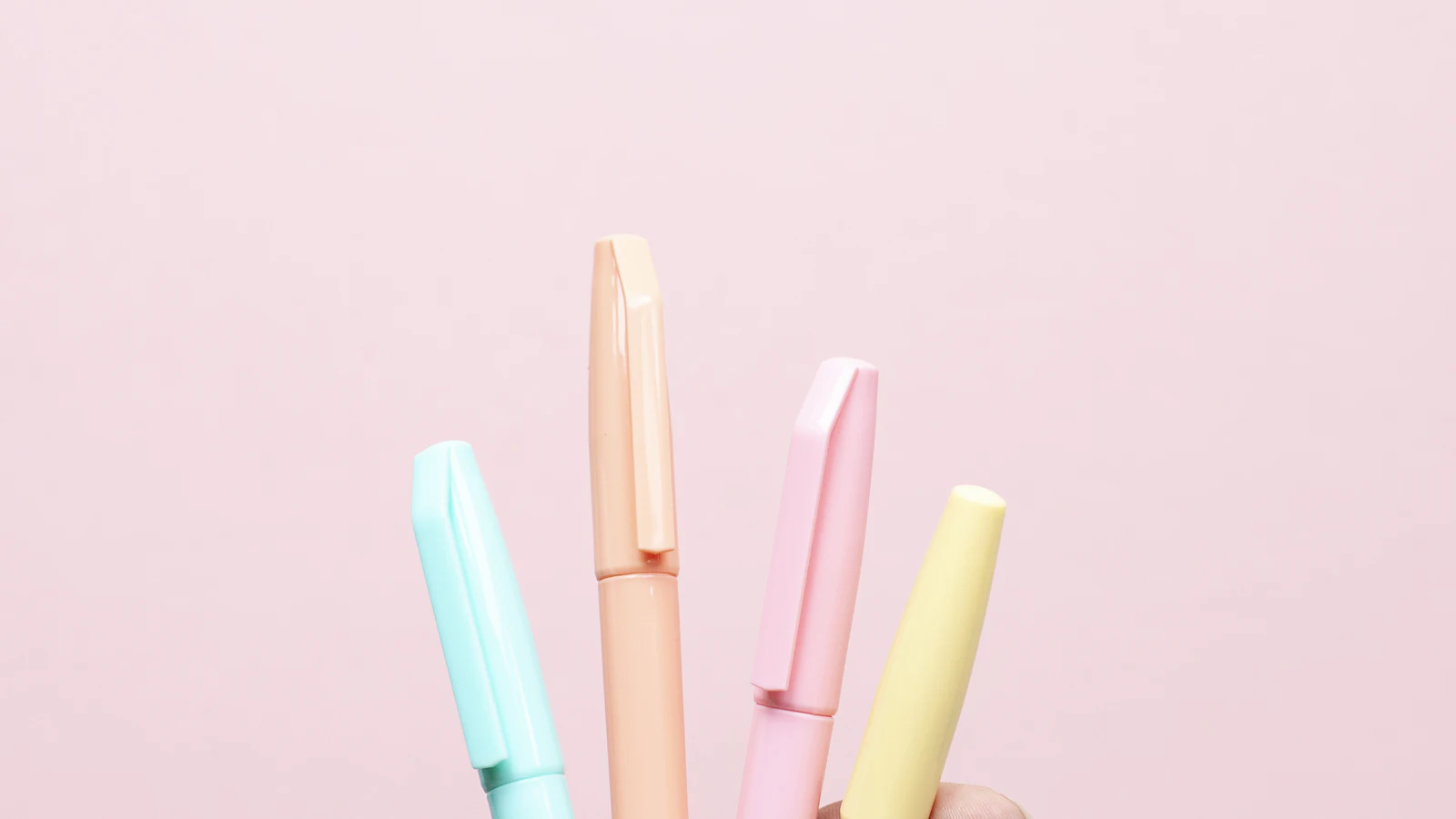
To use a brush pen, hold it at about 45 degrees to the paper, press lightly on upstrokes and harder on downstrokes, and practise on smooth paper. The flexible tip does the rest, giving thin lines when pressed lightly and thick lines when pressed firmly. This guide from Decent Stationery in Lahore explains how to use brush pens, from choosing a tip to the first practice strokes and the faults beginners meet.
Key Takeaways
- The rule is thin up, thick down. Press harder on downstrokes and lighter on upstrokes.
- Hold the pen at about 45 degrees, with the tip pointing to the side of the page rather than the top.
- Use smooth paper. Rough paper frays the tip.
- Wobbly upstrokes are normal at first, and pressure control takes sustained practice.
- Five minutes a day is a good start, according to Zebra.
What Is a Brush Pen?
A brush pen has a flexible tip that makes both thin and thick lines. Love Leigh Loops calls the flexible tip the core feature. Go Konfetti contrasts it with felt-tip pens and fineliners, whose tips keep the same shape, and says the brush pen’s flexible tip produces a calligraphy effect.
There are two main ink types, pigment and water-based, according to Love Leigh Loops. It adds that water-based ink is affected by sunlight and will eventually fade, so it suits practice more than final pieces.
Choosing a Brush Pen
The sources disagree on the best first tip, so the choice is partly a matter of taste.
| Tip | What the source says | Source |
|---|---|---|
| Large tip | Makes bigger letters, so mistakes are easier to see | Love Leigh Loops |
| Small tip | Easier to control. Zebra advises a super fine brush pen for a beginner | Zebra, Archer and Olive |
| Medium tip | Recommended for beginners | Go Konfetti |
| Large, flexible tip | Tombow dual brush markers are harder for beginners to control | Zebra |
Zebra advises choosing one tool at first, since each pen needs different muscle memory, and not buying many pens at once. It adds that expensive pens do not guarantee success. Love Leigh Loops says to measure tip size by the tip and not the body of the pen.
How to Hold a Brush Pen
The hold matters as much as the pen. These points come from the guides we read.
- Angle. Hold the pen at about 45 degrees to the paper. Archer and Olive says you need not calculate it exactly, because an angle between horizontal and vertical is enough.
- Direction. Seen from above, the tip should point toward the side of the page, not the top, according to Love Leigh Loops and EndlessPens.
- Grip. The guides differ on where to hold the barrel. Go Konfetti holds it fairly far up for control, EndlessPens near the middle, and Cowling and Wilcox closer to the tip for more control.
- Movement. Archer and Olive says to move the whole hand and not just the fingers, and to sit with a straight back. Go Konfetti suggests moving the paper instead of your body.
- Left-handed writers. Tombow suggests an overwriter grip to match a right-hander’s angle. Go Konfetti advises drawing slowly so that nothing smudges.
Tombow warns that the wrong angle can fray the tip.
How Pressure Controls the Line
Pressure sets the width of each stroke. Tombow says it directly affects the width, and that heavier pressure gives thicker lines. To press harder, push the pen onto the page so that the tip flexes and more of it touches the paper.
| Stroke | Direction | Pressure | Result |
|---|---|---|---|
| Upstroke | Bottom to top | Light, just touching the paper | Thin line |
| Downstroke | Top to bottom | Firm and constant | Thick line |
Archer and Olive aims for constant pressure from start to finish so that the line stays even. Go Konfetti says a slight scratching sound on downstrokes is a good sign. Zebra says not to be afraid to push down hard, because the tips are meant to be bent, but it also warns that pressure control takes months of consistent daily practice.
Step by Step: Your First Strokes
- Choose smooth paper. See the paper section below.
- Warm up. Go Konfetti starts with a few loose wrist swing exercises.
- Take your hold. Set the pen at about 45 degrees with the tip pointing to the side.
- Draw upstrokes. Touch the paper lightly and draw upward. These are thin lines.
- Draw downstrokes. Press down and keep the pressure level as you draw toward you.
- Join them. Combine an upstroke and a downstroke into an inverted V.
- Learn the turns. For underturns, Archer and Olive begins releasing pressure about three-quarters of the way down. For overturns, do not press until the downstroke begins.
- Add ovals and loops. Start an oval at the end of the thin upstroke.
- Lift between strokes. Zebra reminds us that lettering differs from cursive writing, so lift the pen between strokes.
Archer and Olive lists nine drills in this order, and recommends repeating each one a lot.
| Drill | Order |
|---|---|
| Upstrokes | 1 |
| Downstrokes | 2 |
| Upstroke and downstroke combined | 3 |
| Underturns | 4 |
| Overturns | 5 |
| Ovals | 6 |
| Loops | 7 |
| Ascender loops (for letters such as L and H) | 8 |
| Descender loops (for letters such as G and J) | 9 |
Zebra names seven basic strokes: line, overturn, underturn, compound curve, oval, ascending loop and descending loop. It also suggests starting with monoline letters, which use one line and need no pressure control, and learning lowercase before uppercase.
Paper and Tip Care
The wrong paper shortens a pen’s life. Love Leigh Loops says that brush pens work best on very smooth paper and warns that the wrong paper choice can ruin a brush pen. It adds that watercolour paper is rough enough to damage the tip. Zebra agrees that felt tips fray quickly on rough paper, and Go Konfetti recommends smooth, satin-finish paper to protect the delicate tips.
Cowling and Wilcox suggests the Daler-Rowney Calligraphy Pad. Zebra uses a smooth 32 lb laser printer paper. If you combine brush pens with watercolour, EndlessPens advises applying the brush pen last, after everything else has dried.
Building a Practice Routine
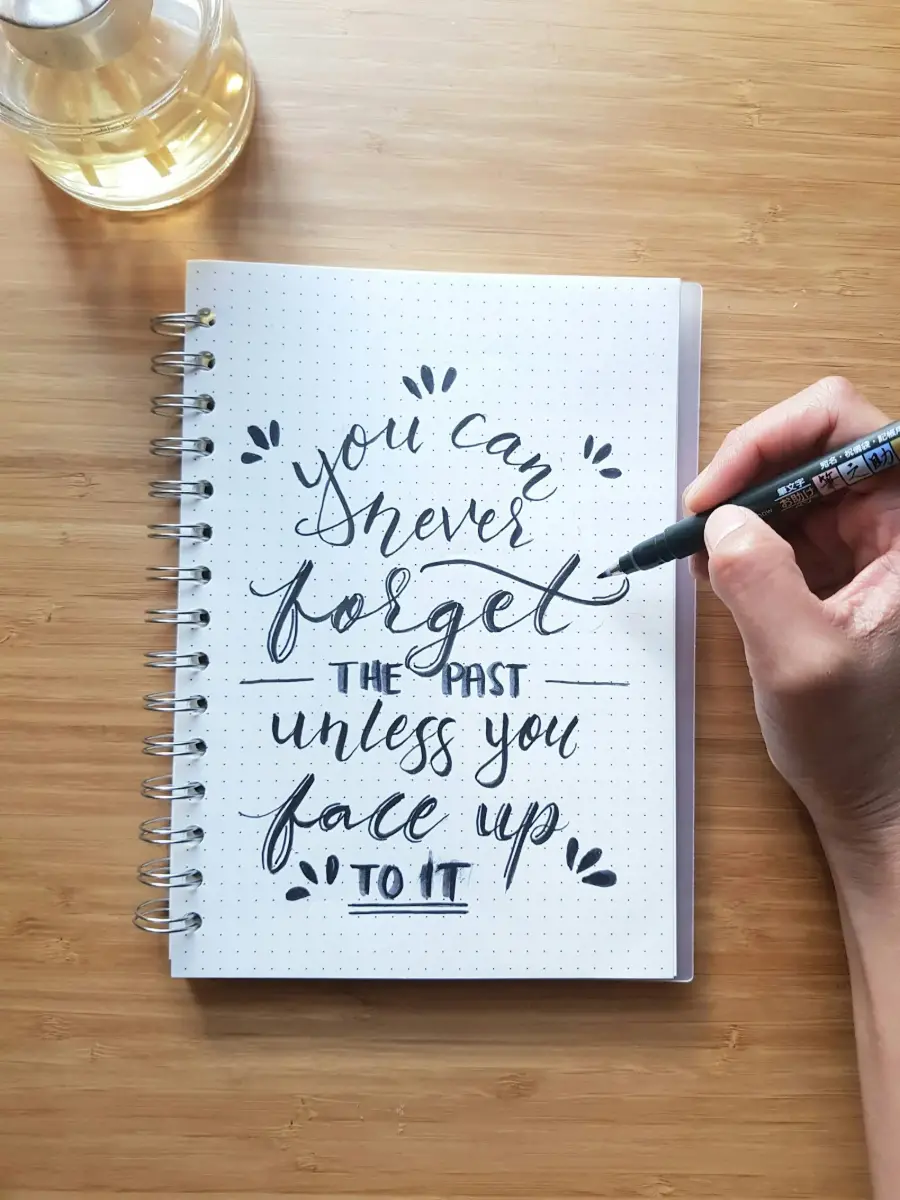
Short, regular sessions work better than long, rare ones. Zebra says that even five minutes a day can make a large difference. Go Konfetti suggests fixed practice times and working lettering into daily life, such as shopping lists and journal entries.
Guide sheets help with consistency. Love Leigh Loops says always to use one, and EndlessPens uses them to keep angles, loop heights and shade thickness even. Zebra suggests tracing paper to build muscle memory, like training wheels, before you develop your own style. Keep your pages together, as Go Konfetti advises, so that you can see your progress.
Common Problems and Fixes
| Problem | Fix | Source |
|---|---|---|
| Shaky or wobbly upstrokes | Normal at first. Slow down and keep practising | Archer and Olive, Go Konfetti |
| Frayed tip | Use smooth paper and keep the pen at an angle | Love Leigh Loops, Tombow |
| Uneven thick strokes | Keep the pressure constant from start to finish | Archer and Olive |
| Lettering looks like handwriting | Lift the pen between strokes | Zebra |
| Colours fade | Water-based ink fades in sunlight, so save it for practice | Love Leigh Loops |
| Hand feels tense | Relax your shoulders, breathe, and move the paper | Zebra, Go Konfetti |
Brush Pens and Markers at Decent Stationery
Our brush pen in Pakistan page is where brush pen listings appear. When we checked it, the page showed no products, so look there for current stock.
The Mont Marte Mighty Markers brush markers come in a pack of eight in yellow, orange, red, pink, purple, blue, green and brown. The page says the brush tip gives more line variation than a standard fibre-tip marker, and the pack is rated for ages three and up. The 605 Master Qalum calligraphy marker is a different tool. It has a 2.5 mm chisel nib for Urdu and Arabic script, not a flexible brush tip. Browse our calligraphy accessories for related pens and sets.
For more reading, see our guides on how to use watercolor tubes, fine art supplies and how to fill ink in a fountain pen.
Frequently Asked Questions
Hold it at about 45 degrees to the paper, with the tip pointing toward the side of the page. Zebra, Love Leigh Loops and EndlessPens all give 45 degrees.
Press harder on downstrokes for thick lines and lighter on upstrokes for thin ones. Tombow says heavier pressure gives thicker lines.
Smooth paper. Love Leigh Loops says brush pens work best on a very smooth surface, and Zebra says felt tips fray quickly on rough paper such as watercolour paper.
The guides differ. Love Leigh Loops recommends a large tip, Zebra a super fine one and Go Konfetti a medium one. Zebra advises starting with one pen only.
Zebra says pressure control takes months of consistent daily practice. It also says that even five minutes a day can make a large difference.
Go Konfetti says wobbly upstrokes are normal at first, and Archer and Olive says not to worry if early lines are shaky or uneven.
Conclusion
A brush pen rewards slow, regular practice. Learn the 45 degree hold, remember thin up and thick down, protect the tip with smooth paper, and build the strokes one drill at a time. When you are ready for pens, markers and practice supplies, Decent Stationery in Lahore can help.
Related Reading
- What Is Calligraphy Art? Meaning, Styles and Tools
- Difference Between Soft Pastels and Oil Pastels
- How to Shade With Colored Pencils
Sources and Further Reading
- Zebra Pen: Brush lettering for beginners
- Love Leigh Loops: How to use brush pens
- Archer and Olive: Beginner hand lettering with brush pens, tips and drills
- Tombow USA: Applying pressure in brush calligraphy
- Go Konfetti: Brush lettering for beginners
- EndlessPens: How to use ink brush pens
- Cowling and Wilcox: How to get started with brush lettering
About the Author
Written by the Decent Stationery team in Lahore. We stock school, office and art supplies, and we write practical guides to help students, parents and teachers across Pakistan get more from them.