
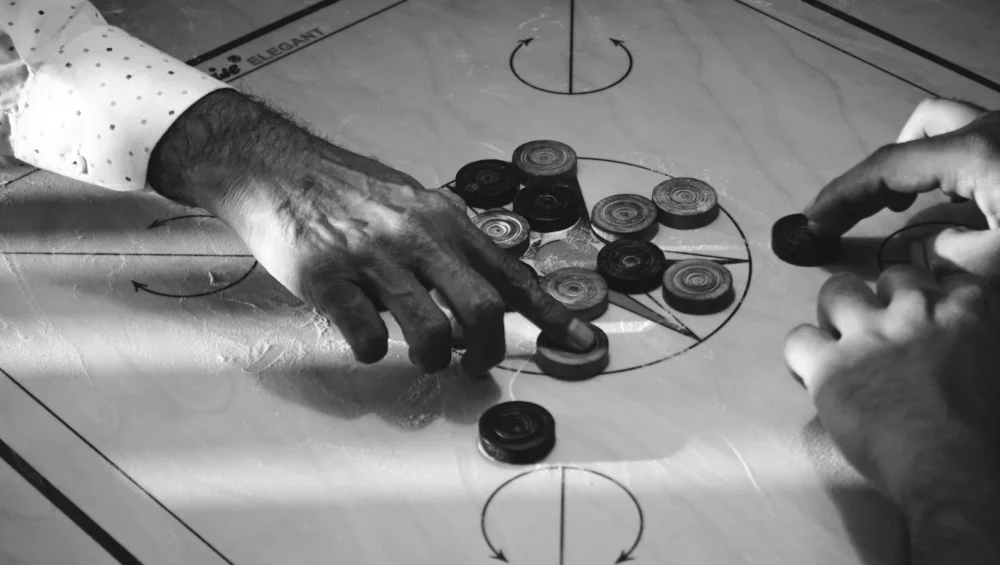
Here is how to play carrom board in brief. Two or four players sit around a square wooden board. Each flicks a striker with one finger to knock their own colour of carrom men, nine white or nine black, into the corner pockets. A player who pockets a piece shoots again. The red queen may be taken after your first piece, but it must be “covered” by pocketing one of your own pieces straight afterwards. The first player to clear their colour, with the queen covered, wins the board. This guide from Decent Stationery in Lahore explains the setup, the strike, the scoring and the usual fouls.
Key Takeaways
- A carrom set has 19 pieces: 9 white, 9 black and 1 red queen, plus one striker.
- You must flick the striker. Pushing it is a foul.
- Pocketing one of your own pieces earns another turn. A miss passes the turn on.
- The queen is worth 3 points and must be covered at once, or it goes back to the centre.
- Rules differ a little between rule sets, so agree the scoring before the first shot.
What Do You Need to Play Carrom?
Short answer: a carrom board, 19 carrom men, a striker and a little board powder.
Wikipedia gives the standard international playing surface as 74 by 74 cm, with a border of 5 to 10 cm and a pocket in each corner. A set holds 19 pieces besides the striker. The same page puts the striker at about 15 grams and 4.1 cm across, larger and heavier than the carrom men. Dawn, a Pakistani newspaper, describes the men as wooden and the striker as up to 4.13 cm across.
Big Game Hunters advises setting the board on a level surface 60 to 70 cm above the floor and dusting it lightly with carrom powder. The CBC adds that powder that has turned granular can be replaced with boric acid, sold at drugstores.
| Item | Number | Notes |
|---|---|---|
| White carrom men | 9 | One colour per player or team |
| Black carrom men | 9 | The other colour |
| Red queen | 1 | Placed at the centre |
| Striker | 1 | Flicked, never pushed |
| Pockets | 4 | One in each corner |
How to Set Up a Carrom Board
Short answer: place the queen in the centre, ring it with six pieces, then add twelve more in an outer ring, alternating colours.
Masters of Games sets out the arrangement as follows.
- Put the queen on the centre spot.
- Arrange six pieces in an inner circle, each touching the queen and its neighbours.
- Arrange twelve pieces in an outer circle, each touching the inner circle.
- Alternate the colours in each circle.
- Line up the queen, one white inner piece and one white outer piece in a straight line pointing toward the first player.
Singles players sit opposite each other. In doubles, partners sit opposite, so that opponents are at either side. Tutorialspoint adds that the arrangement must not cross the outer circle.
Who plays first?
Masters of Games describes a simple toss. One player hides a piece in a closed hand and the opponent guesses which hand holds it. The CBC mentions flipping a coin instead. The Bradley’s summary says the player who breaks, that is the first to shoot, plays white.
How to Hold and Flick the Striker
Short answer: place the striker on your baseline, flick it forward with one finger, and never push it.
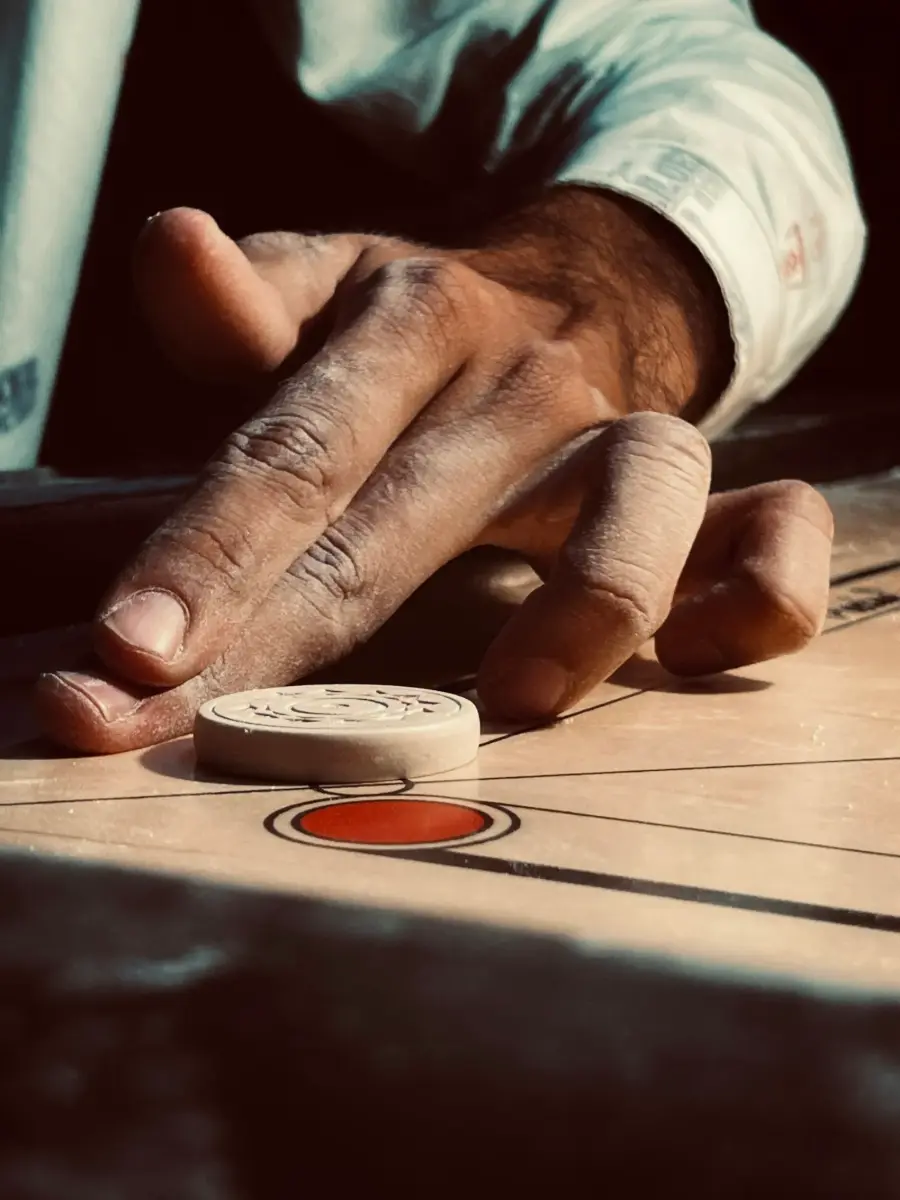
The CBC quotes Francis D’Costa, founder of Carrom Canada, who recommends one finger for beginners. He says “One finger is better because you’re using less space on the board.” Several points on striking come from the rule summaries.
- Place the striker on the baseline in front of you so that it touches both baseline ends, or on one of the circles at either end, according to Masters of Games and the rule summary hosted by F.G. Bradley’s.
- Flick it so that it crosses the front baseline. Backward or sideways flicks are not allowed, says Big Game Hunters.
- Your hand may cross the diagonal arrow line, but your elbow may not extend over the frame, and your feet and knees must stay in your own quarter, according to the Bradley’s summary.
- On the opening shot you have three attempts to place and strike correctly. After that the turn passes.
The CBC also gives practical advice from D’Costa. Keep nails short, sit near the edge of the chair so you can shift position, and avoid hitting too hard. He compares aiming to a clock face, where striking a piece at the six position sends it straight.
How Does a Turn Work?
Short answer: you keep shooting while you pocket your own pieces, and you lose the turn when you miss or commit a foul.
Masters of Games says that pocketing one of your own pieces, or the queen, earns another strike once you have retrieved the striker. Pocketing nothing, or fouling, ends the turn. Pieces that jump off the board are returned to the centre, according to Big Game Hunters. The Bradley’s summary adds that if the centre spot is partly covered, the piece is placed to cover as much of the red as possible.
How do you pocket the queen?
Short answer: pocket one of your own pieces first, then take the queen and cover it.
The Bradley’s rule summary states that the queen may be pocketed at any time after your first piece but before your last. After pocketing it you must pocket one of your own pieces on your next shot, which covers it. If you pocket your own piece and the queen on the same shot, the queen is covered automatically. If you fail, the queen goes back to the centre spot.
How Is Carrom Scored?
Short answer: the winner of a board scores 1 point for each piece the opponent has left, plus 3 for the queen if covered.
| Rule | Figure | Source |
|---|---|---|
| Winner’s points per opponent piece left | 1 | CBC, Bradley’s summary |
| Queen, if the winner covered it | 3 | CBC, Wikipedia |
| Queen points stop once a score reaches | 22 | CBC, Bradley’s summary |
| Game length | 25 points or 8 boards | CBC, Bradley’s summary |
Sources do not agree on every figure. Wikipedia and Tutorialspoint give 21 for the queen limit, while the CBC and the Bradley’s summary give 22. Masters of Games and Big Game Hunters describe a longer game to 29 points, with a 5 point bonus for covering the queen. Wikipedia also describes a simpler scheme for children or odd numbers of players, called point carrom, where black counts 1, white 2 and the queen 5, and the first to 25 wins.
For a family game, the easiest choice is to count the opponent’s remaining pieces at the end of each board and play to 25.
Common Fouls and Their Penalties
Short answer: the usual fouls are pocketing the striker, pocketing an opponent’s piece, and breaking the striking rules.
The Bradley’s rule summary lists these penalties.
| Foul | Penalty |
|---|---|
| Pocketing the striker | You lose one piece and your turn. Your opponent places the piece in the centre circle. |
| Pocketing an opponent’s piece | You lose your turn |
| Pocketing the opponent’s last piece | You lose the board and 3 points |
| Pocketing your last piece before the queen | You lose the board, 3 points, and 1 point per opponent piece left |
Big Game Hunters adds that touching any piece other than the striker, or failing to break within three attempts, is also a foul. If you have no pocketed piece to return, you owe one and repay it with the first you pocket.
Carrom in Pakistan
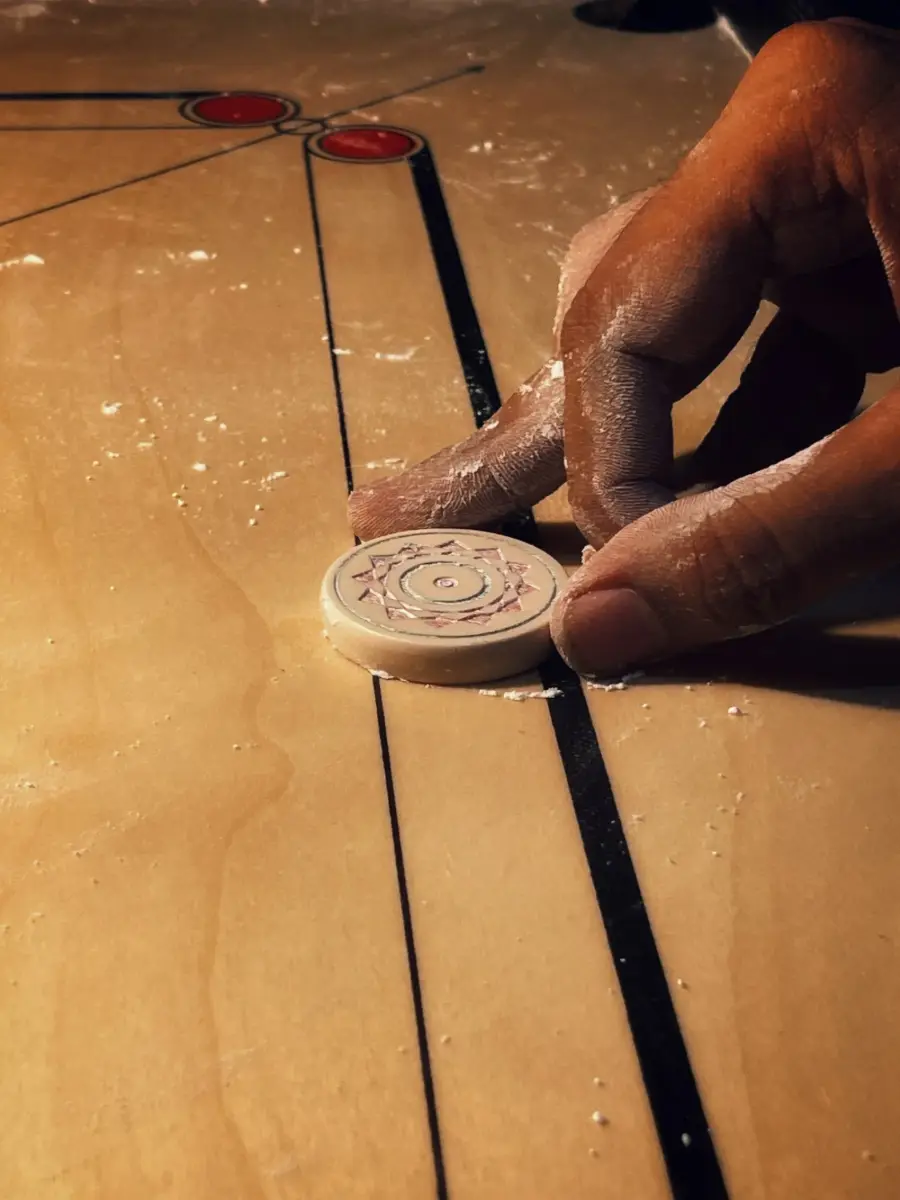
Dawn reports that the Pakistan Carrom Federation was established in 2004 as the national chapter of the International Carrom Federation. In 2005 Pakistan took part in the first Asian Carrom Championship in Male, Maldives, and about 40 countries play in the main international events, the article says. Dawn also records a local game called Dubbo, played standing, on larger boards and with any fingers. Wikipedia notes that the game is widely played in families and at social gatherings across South Asia.
At home, rules often differ from the federation’s rules, so it helps to settle three things before play: the scoring, whether the queen needs covering, and what happens to a striker that falls into a pocket.
Decent Stationery’s guide to sports equipment and educational toys notes that its board games range includes carrom and that carrom boards are sold with the accessories needed to play. You can look at the current range under carrom board, though stock changes, and ludo is a good second game for the same table. If younger children prefer a quieter activity between games, our guide on how to make flash cards for kids may help.
A Short History of Carrom
Wikipedia states that carrom originated in India and that serious tournaments may have begun in Sri Lanka in 1935. India and Sri Lanka both had official federations by 1958, and the International Carrom Federation was formed in 1988 in Chennai. The CBC notes that the exact origins are unconfirmed and that the game became popular across South Asia after the First World War.
Frequently Asked Questions
Two or four. The Bradley’s rule summary describes singles and doubles, with partners sitting opposite each other in doubles. Wikipedia also mentions point carrom for children or an odd number of players.
There are 19 pieces: 9 white, 9 black and 1 red queen, plus a striker, according to Wikipedia.
Three points under the usual rules, as the CBC and Wikipedia state, but only if the winner of the board covered it. Some family rules use other values.
No. The striker must be flicked, says the CBC. Masters of Games lists breaking the striking rules as a foul.
Powder is optional, but it helps the pieces slide. Masters of Games calls it optional and names boric acid as the most popular choice. Big Game Hunters advises a light dusting.
It is a foul. Under the Bradley’s summary you lose one piece and your turn, and your opponent places the penalty piece in the centre circle.
Conclusion
Carrom is easy to learn and slow to master. Set the pieces in the centre, flick with one finger, cover the queen, and keep a simple score on paper. Play one practice board with the fouls above in mind, then agree the house rules for the next. When you are ready to choose a board or a second game, visit Decent Stationery.
Related Reading
Sources and Further Reading
- Wikipedia: Carrom
- Masters of Games: The Rules of Carrom or Karom
- Big Game Hunters: How to Play Carrom
- F.G. Bradley’s: Carrom Rules (International Carrom Federation summary)
- CBC Life: The Beginner’s Guide to the Greatest Pastimes, Carrom
- Dawn: Carrom in Pakistan, Sunday Magazine, 18 May 2014
- Tutorialspoint: How to Play Carrom
About the Author
Written by the Decent Stationery team in Lahore. We sell school, office, sports and toy stationery online across Pakistan. Rules, sizes and dates come from the linked sources, and shop details from our own pages.