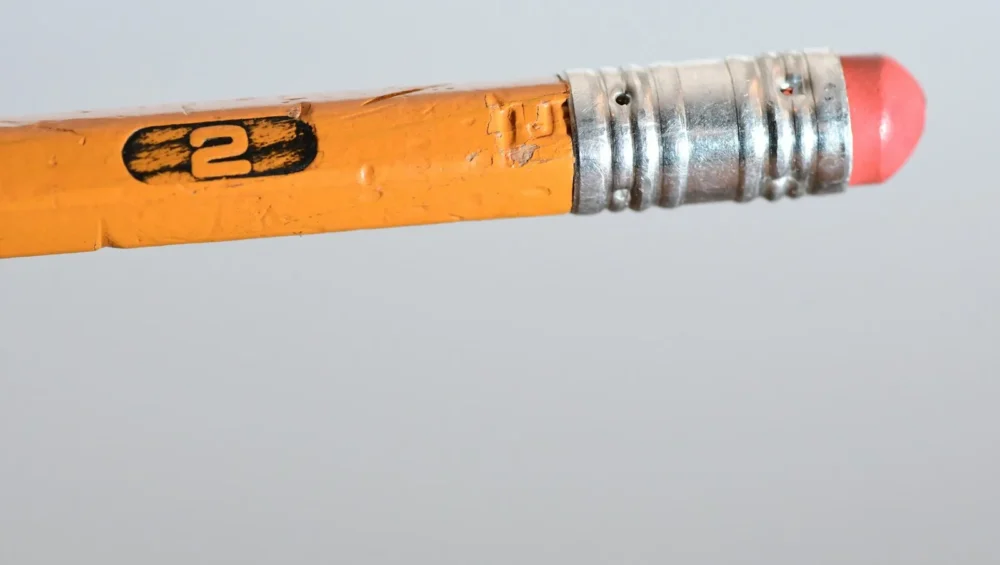
Erasers are made by mixing rubber or vinyl with fillers, softeners and colour, shaping the mixture, curing it with heat, and cutting it to size. Most pencil erasers use synthetic rubber, while softer vinyl erasers use plasticised PVC. This guide from Decent Stationery explains the materials, the steps in the factory, why many erasers are pink, and how an eraser lifts pencil marks from paper.
Key Takeaways
- Most rubber erasers combine synthetic rubber, sulfur, pumice, vegetable oil and pigment.
- Vinyl erasers use PVC and a plasticiser, and need no vegetable oil.
- Heat and sulfur cure the rubber in a step called vulcanisation, invented by Charles Goodyear in 1839.
- Pencil-end erasers are extruded and cut, while loose erasers are moulded.
- Erasers remove graphite but not ink, because ink soaks into the paper.
What Are Erasers Made Of?
Short answer: a typical rubber eraser is made of rubber, sulfur, a mild abrasive, a softening oil and pigment. A vinyl eraser is made of PVC, a plasticiser and a chalk filler.
Encyclopedia.com lists rubber as the main ingredient. It can be natural, taken from the latex of the Hevea rubber tree, or synthetic, most commonly styrene-butadiene rubber made from chemicals derived from petroleum. Sulfur is added to almost all erasers so that the rubber can be vulcanised. QualityLogoProducts adds that calcium carbonate, which is chalk, is used as a filler in synthetic rubber erasers. The table below sets out the main ingredients and what each one does.
| Ingredient | What it does | Source |
|---|---|---|
| Natural or synthetic rubber | Forms the body of the eraser | Encyclopedia.com |
| Sulfur | Allows the rubber to be vulcanised, which makes it durable | Encyclopedia.com |
| Pumice | Adds a mild abrasive action | Encyclopedia.com |
| Vegetable oil | Softens the rubber | Encyclopedia.com |
| Calcium carbonate (chalk) | Filler in rubber and vinyl erasers | QualityLogoProducts |
| Zinc oxide, titanium oxide, iron oxide, organic dyes | Pigments (white, red and other colours) | Encyclopedia.com |
| PVC with a plasticiser | Base of vinyl erasers | QualityLogoProducts |
How Are Erasers Made Step by Step?
Short answer: the maker prepares the rubber, mixes in the other ingredients, cures the mixture with heat, shapes it, cools it, cuts it, and finishes it with printing or a metal ferrule. The exact order differs between factories.
Step 1: Preparing the rubber
Natural rubber begins as latex, which workers collect by cutting a thin strip of bark from the tree. According to Encyclopedia.com, the latex is strained, mixed with water, and treated with dilute acetic or formic acid so that the rubber coagulates into slabs. The slabs are squeezed, then packed into bales of 225 to 250 pounds. Synthetic rubber is made by combining styrene and butadiene, both obtained from petroleum, with water, soap and a catalyst. It is shipped as a powder or liquid.
Step 2: Mixing the ingredients
The rubber is blended with pigment, vegetable oil, pumice, sulfur and other additives. Encyclopedia.com notes that synthetic rubber mixes more easily because it arrives as a powder or liquid, while natural rubber must first be pulverised or dissolved in a solvent. QualityLogoProducts says synthetic rubber is mixed on giant rollers using heat and motion.
Step 3: Vulcanising the rubber
Heat makes the sulfur react with the rubber, which becomes more stable, durable and flexible. Charles Goodyear discovered the process in 1839, as Wikipedia and Encyclopedia.com both record. Wikipedia notes that raw rubber stays perishable until it is vulcanised.
Step 4: Shaping the eraser
Encyclopedia.com describes two routes. For erasers that sit on the end of a pencil, called plugs, the soft mixture is forced through a die to form a long cylinder, which is cut into short lengths as it emerges. For loose erasers, called flats, the warm liquid mixture is forced into moulds. QualityLogoProducts describes another method in which the warm rubber is cut into large squares and later chopped into small rectangles. Methods therefore vary from one maker to another.
Step 5: Cooling and cutting
As the material cools, it changes from a thick, viscous state into a soft solid. Moulded pieces set inside the mould. Strips of vinyl are cooled by fans on a conveyor belt and then cut with a guillotine, according to QualityLogoProducts.
Step 6: Finishing and checking
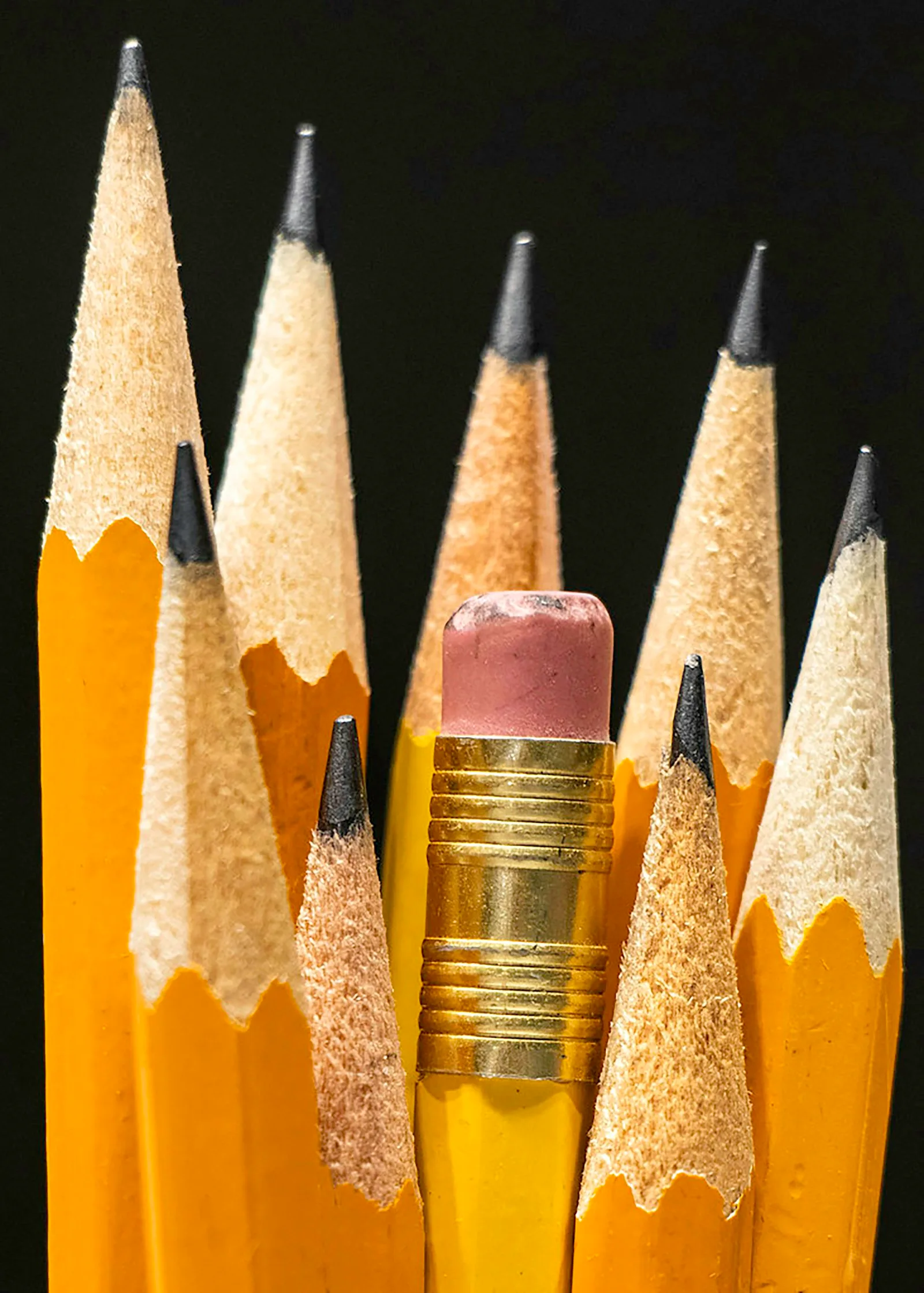
Plugs go to pencil makers, who fix them in place with a metal ferrule. Encyclopedia.com says the ferrule is plain aluminium on cheaper pencils and painted brass on dearer ones. Loose erasers may be stamped, screen printed or embossed, and QualityLogoProducts notes that pad printing is common for logos. The process is highly automated, and only a small percentage of erasers are checked for size and hardness.
How Are Vinyl Erasers Made Differently?
Short answer: vinyl erasers are made from PVC plastic softened with a plasticiser, so they need no sulfur curing and no vegetable oil.
QualityLogoProducts explains that PVC is mixed in a large vat with a central stirring pole, which produces a white liquid. The liquid is either pushed onto a conveyor belt as a long strip or poured into an injection mould. Wikipedia reports that plasticised vinyl is softer, less abrasive and erases more cleanly, which is why engineers favour it for technical drawings. McGill University adds that vinyl erasers are gentler on paper and avoid rubber and latex allergy problems. It also warns that the plasticiser dioctyl phthalate has raised environmental concerns.
Why Are Most Erasers Pink?
Short answer: the colour is mostly tradition. The sources give two explanations for how it began.
QualityLogoProducts says early erasers took their pink colour from pumice, and that most makers no longer use it but still add pink because people expect erasers to be pink. McGill University offers a different account. It says the accelerator once used to join the rubber molecules was pink, the colour became a tradition, and makers now add pink dye. Both agree that today the colour is added on purpose.
How Does an Eraser Remove Pencil Marks?
Short answer: it rubs graphite particles off the paper and holds them, so they do not settle back.
McGill University describes erasing as abrasion. A soft abrasive lifts the thin layer of graphite without tearing the paper, so the eraser cannot be too harsh. The pumice mixed into many erasers is finely ground and, McGill says, is about 75 percent silicon dioxide and 25 percent aluminium oxide. Vaessen Creative adds that the friction loosens the graphite and the slightly sticky surface of the eraser carries it away.
Why can an eraser not remove ink?
McGill University gives a plain reason. Ink soaks into the paper, while graphite sits on the surface. To remove ink, an eraser would have to dig into the paper and damage it. If you make an error in ink, a correction pen is the better tool, and our article on how to use a correction pen explains it.
A Short History of the Eraser
Before rubber, writers used other things to rub out marks. Wikipedia lists wax tablets, rough stones such as pumice, and crustless bread.
| Year | Event |
|---|---|
| 1770 | Joseph Priestley describes the rubber eraser sold by Edward Nairne, an English instrument maker |
| 1839 | Charles Goodyear discovers vulcanisation |
| 1858 | Hymen Lipman of Philadelphia receives a patent for a pencil with an eraser attached, later invalidated |
| 1872 | The Eagle company makes pencils with erasers fitted into the wooden case |
Encyclopedia.com reports that about 90 percent of modern American pencils have attached erasers, while pencils without erasers are more common in Europe.
What Types of Eraser Are There?
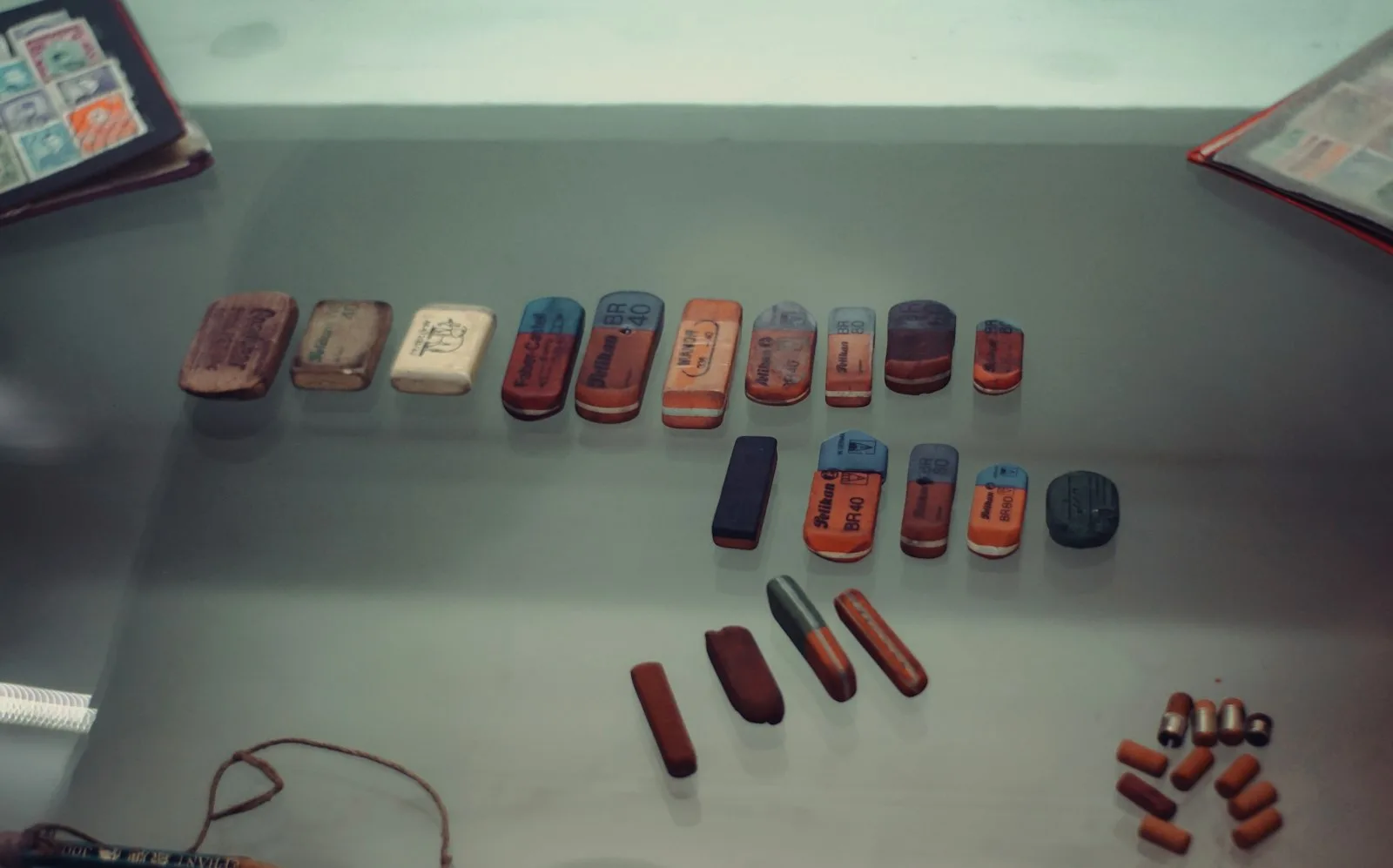
The type you need depends on the paper and the pencil. Wikipedia describes the main kinds in this way.
| Type | Description |
|---|---|
| Cap | A cone that slips onto the end of a pencil |
| Art gum | Very soft and crumbly, good for large areas, leaves residue to brush away |
| Kneaded | Pliable, can be shaped for fine detail, wears out as it collects particles |
| Click or barrel | A pencil-shaped holder with a retractable stick, usually soft vinyl |
Choosing an Eraser in Pakistan
Students in Pakistan usually buy erasers in boxes or jars for the school year. You can browse eraser in Pakistan at Decent Stationery, including the Bahadur B-72 Triangle Eraser (Box of 72), the ORO Neeto Colorful Soft Erasers (25 Pcs) and the Burooj Dust Free Erasers (Jar of 60). We have not tested what these particular products are made of, so check the pack or ask the maker if the material matters to you. Vaessen Creative advises choosing a synthetic eraser if anyone has a latex sensitivity, and a vinyl eraser for fine paper.
An eraser is one part of the school kit. Pencils need a sharp point, and our guide on how to sharpen a pencil without breaking the lead shows how. For geometry work, a parent may also wish to read our guide to choosing a geometry box and see the compass in Pakistan range.
Frequently Asked Questions
Most pencil erasers are made of synthetic rubber, sulfur, pumice, vegetable oil and pigment. Vinyl erasers are made of PVC with a plasticiser and a chalk filler.
No. Rubber erasers use natural or synthetic rubber, while vinyl erasers use plasticised PVC. Art gum and kneaded erasers are different again.
It is a heating process in which sulfur reacts with rubber to make it durable. Charles Goodyear discovered it in 1839, and rubber erasers became common afterwards.
The sources give two explanations. QualityLogoProducts links the colour to early pumice, and McGill University links it to a pink accelerator. Today makers add pink dye because people expect it.
Not an ordinary one. McGill University explains that ink soaks into the paper while graphite sits on the surface, so removing ink would damage the paper.
Vinyl erasers are softer and less abrasive than rubber ones, according to Wikipedia and Vaessen Creative, so they suit fine paper.
Conclusion
An eraser is a simple object with a careful recipe. Rubber or vinyl forms the body, sulfur or plasticiser gives it the right texture, a mild abrasive does the rubbing, and colour is added last. Once you know this, it is easier to choose one that suits your paper and your pencil. The next step is to look at the eraser range at Decent Stationery and pick a box or jar that fits your school year.
Sources and Further Reading
- Encyclopedia.com: Eraser
- QualityLogoProducts: How Erasers Are Made
- Wikipedia: Eraser
- McGill University Office for Science and Society: How Do Erasers Work
- Vaessen Creative: Discover What Is Inside Your Eraser
About the Author
Written by the Decent Stationery team in Lahore. We sell school, office and art stationery online across Pakistan, including erasers, pencils and geometry tools. The facts in this guide come from the sources linked above.