
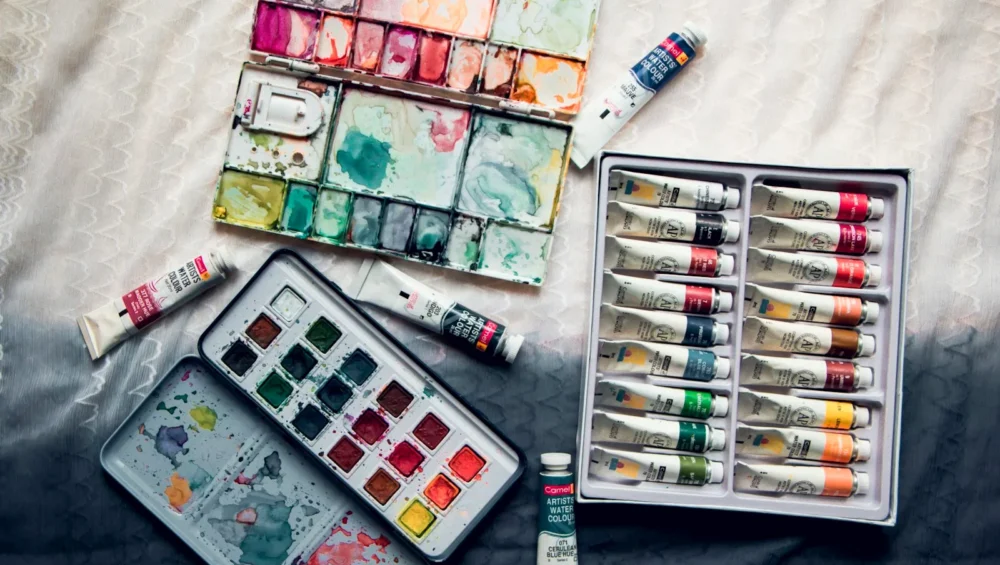
To use watercolor tubes, squeeze a small amount of paint into the wells of a palette, add a couple of drops of water, then touch a clean wet brush to the paint and mix until it is smooth. Add more water for a pale wash or less for stronger colour. This guide from Decent Stationery explains each step and how to look after your tubes.
Key Takeaways
- Squeeze a little more paint than you think you need, because an exact mix is hard to repeat.
- Tubes are wetter than pans, so they contain less pigment by volume.
- Tubes suit large washes. Pans suit travel.
- Dried tube paint can be rewetted with a few drops of water, though some brands are harder to reactivate.
- A tube that has solidified cannot be made liquid again.
What Are Watercolor Tubes?
Short answer: watercolor tubes hold moist paint that you squeeze out and mix with water.
Dick Blick explains that tube colours come out fluid, so they mix with water instantly and let you prepare a large amount of colour quickly. They also offer a wide range of paint body, from thin washes to thick highlights. Jackson’s Art Supplies points out that tubes are wetter than pans and so hold less pigment by volume, since some of the volume in a tube is water. The same article says tubes and pans are often the same paint, with water added to the tube version.
Watercolor Tubes or Pans?
Short answer: choose tubes for big paintings and pans for a travel kit.
| Point | Tubes | Pans |
|---|---|---|
| Large washes | Better, because the paint is already fluid | Harder, since large brushes do not fit standard pans |
| Portability | Caps must stay clean and tight, and tubes can leak on flights | The usual choice for portable paint boxes |
| Cost | More economical, though small tubes cost more per millilitre | Cost more for the same amount of paint |
| Strength | Less concentrated, as part of each tube is water | More concentrated |
| Drying out | Can dry out in the tube | Stored dry, so no drying-out concern |
This table draws on Jackson’s Art Supplies and Dick Blick. WatercolorPainting.com adds that the two forms differ in convenience rather than quality.
What Do You Need Besides the Tubes?
Jackson’s Art Supplies lists the basics for a beginner. You need paper, brushes, a palette and a pot of water.
- Paper. Hot-pressed paper is smooth for fine lines. Cold-pressed paper has a slight texture and is what most artists start with. Rough paper gives broken, expressive strokes. Winsor and Newton notes that watercolour paper is absorbent and can take large amounts of water without cockling.
- Brushes. Start with at least three shapes, such as flat, round and filbert. Small brushes handle detail and large ones hold more liquid for washes.
- Palette. Porcelain palettes avoid beading entirely. Metal or plastic palettes make paint bead up unless scrubbed clean. A palette with a lid protects mixed paint.
- Water. A glass jar is enough at home.
How to Use Watercolor Tubes Step by Step
Step 1: Squeeze paint onto the palette
WatercolorPainting.com advises putting small amounts of paint into the wells, and squeezing out more than you think you will need. Group the colours by family so they are easy to find.
Step 2: Add a few drops of water
The same guide recommends adding a couple of drops to each well. This lets you see the true colour and prevents a hard skin from forming. It says water at this stage is optional, since a small amount of concentrated paint helps when you need saturated colour. The guide gives no fixed paint-to-water ratio, so judge by eye and test on scrap paper.
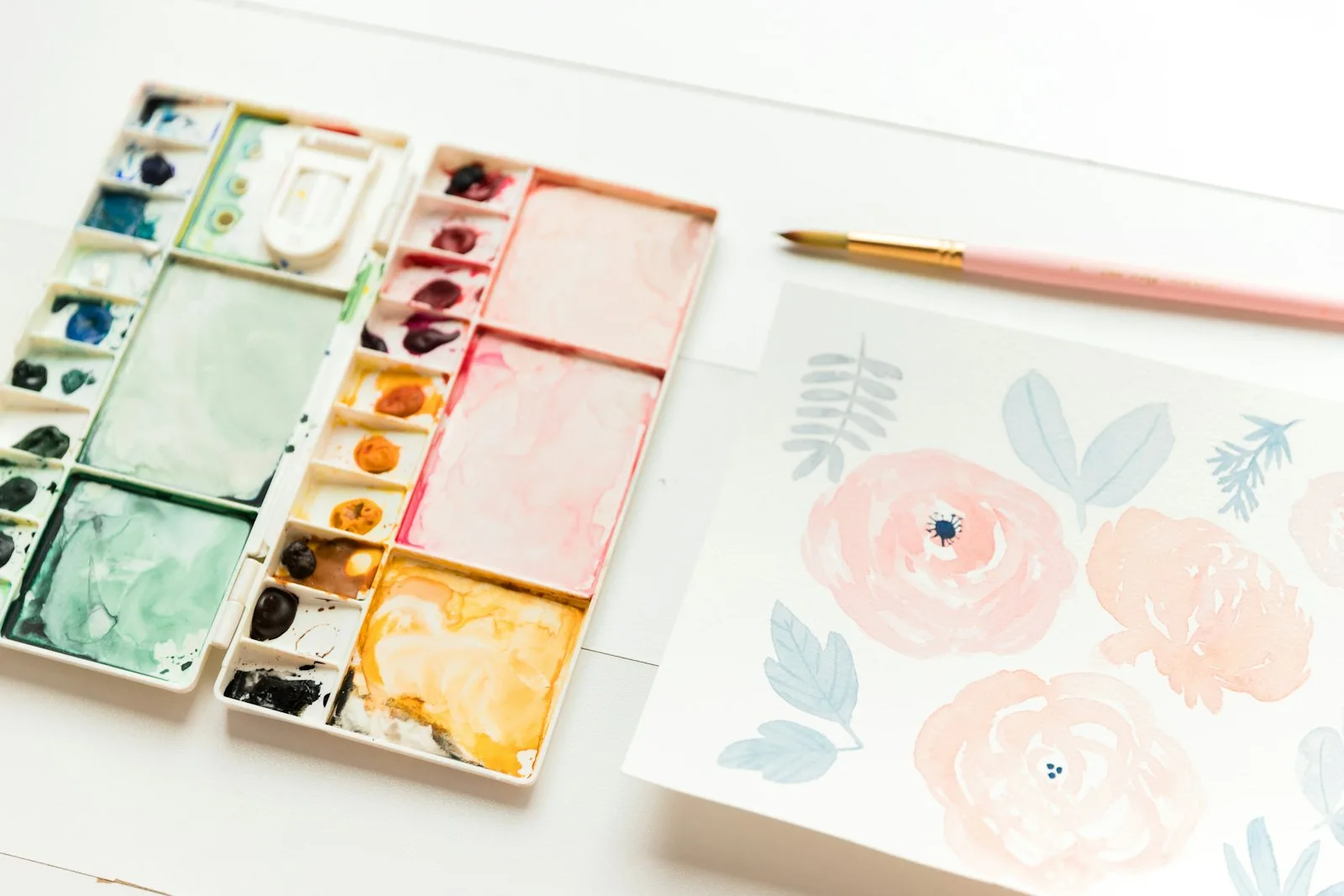
Step 3: Pick up the paint with a clean, wet brush
Dip a clean brush in water, touch it to the paint, and mix until smooth. Clean the brush before each pickup, especially when wells sit close together. Winsor and Newton explains that the belly of a brush controls how much liquid it holds. The bigger the belly, the more water and paint it carries.
Step 4: Control the strength
Test the strength of each mix before it touches the painting. Winsor and Newton adds that dry brush, meaning less water, leaves scratchy, pigmented marks, which is useful for texture.
Step 5: Clean up and store the palette
Leave the paint in the wells to dry, since it can be reused. WatercolorPainting.com suggests covering the palette with foil or using one with a lid to limit dust. It also says a palette kept in the refrigerator limits evaporation and mold.
How Do You Use Dried Tube Paint?
Short answer: wet it with a spray of water or a few drops and wait for it to soften.
Jackson’s Art Supplies says to spray the palette or add a few drops of water before use. Some brands dry hard and become difficult to reactivate, and dried tube paint can be harder on brushes. Dick Blick says dried tube paint can crack or split on the palette, and that gum arabic or glycerine can improve rewetting and reduce cracking. It also warns that repeated drying and rewetting may reduce the paint’s peak appearance and handling.
Can You Refill Pans From Tubes?
Yes. WatercolorPainting.com gives these steps.
- Label empty pans with a waterproof pen.
- Shake or gently massage the tube before opening it.
- Fill each pan about halfway and stir with an unfolded paper clip or toothpick to release air bubbles.
- Let it dry uncovered, then fill the remaining space, leaving room for a few drops of water.
Jackson’s Art Supplies says the paint needs one to two days to dry and the pan can shrink by up to 50 per cent, so you may need to top it up.
How Do You Care for Watercolor Tubes?
Winsor and Newton gives three tips to prolong tube life. Keep the threads on the tube neck free of paint, replace the lids tightly, and store the tubes at an ambient temperature. If a tube has solidified, the same guide says it cannot be returned to liquid form, but you can add a small amount of gum arabic medium to water, use the mixture on the dried paint, and treat it as a pan colour. WatercolorPainting.com suggests that if paint turns sticky you place the tube cap-down in warm water, and that you never leave tubes open for long.
Common Mistakes to Avoid
- Squeezing out too little. A mix is hard to repeat exactly.
- Dirty brushes. Clean the brush before each colour, or your mixes turn muddy.
- Soap residue on the palette. Jackson’s Art Supplies says a metal or plastic palette must be rinsed with no soap left, or the paint will bead.
- Leaving tube caps loose. The paint dries inside.
- Using the wrong paper. Winsor and Newton says watercolour paper is made to take large amounts of water without cockling.
Choosing Watercolors in Pakistan
Decide first whether you will paint at a desk or on the move. A desk painter can enjoy the economy and wet washes of tubes. A student who carries paints to class may prefer pans. At Decent Stationery you can check the watercolor collection for what is currently available. If you also want to try a different paint, see our acrylic paint range. Our fine art supplies guide covers brushes, paints and pencils, and our craft punches, glitter and stencils guide suits school projects.
Frequently Asked Questions
Squeeze out a small amount, but a little more than you think you need. WatercolorPainting.com notes that it is hard to recreate a mix exactly, so mix enough for the whole painting.
Yes. Jackson’s Art Supplies says you can spray the palette or add a few drops of water to soften dried paint. Dick Blick adds that dried tube paint varies by brand, and that gum arabic or glycerine can improve rewetting.
Neither is better in every case. Dick Blick says tubes suit large fluid washes and a wide range of paint body, while pans suit portability. WatercolorPainting.com says there is no quality difference between them.
Winsor and Newton says that once colour has solidified in the tube it cannot return to liquid form. Keeping the neck threads clean and the lid on tightly helps prolong tube life.
Jackson’s Art Supplies recommends a porcelain or ceramic palette, because metal or plastic palettes make watercolor bead up. A palette with a lid protects mixed paint.
Yes. Jackson’s Art Supplies says cold-pressed paper has a slight texture and is where most artists start, while hot-pressed paper is smooth and suits fine detail.
Conclusion
Watercolor tubes are simple to use once you know the routine. Squeeze out a little more paint than you expect to need, add a few drops of water, mix with a clean wet brush, and let leftover paint dry in the palette for later. Keep the tube necks clean and the caps tight. When you are ready to start, visit Decent Stationery and explore our watercolor range.
Sources and Further Reading
- Jackson’s Art Blog: Is Watercolour Better in Pans or Tubes?
- Jackson’s Art Blog: Watercolour Painting for Beginners
- WatercolorPainting.com: Beginners Guide to Using Watercolour Paint Tubes
- Dick Blick: Watercolor Tubes Versus Pans
- Winsor and Newton: How to Rescue Tubes of Solidified Watercolour
- Winsor and Newton: Your Top Ten Watercolour Questions Answered
About the Author
Written by the Decent Stationery team in Lahore. We sell school, office and art stationery online across Pakistan, including watercolors. The advice in this guide comes from the paint makers, retailers and art educators linked above.